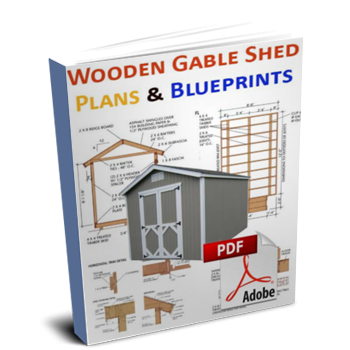
Build A DIY Shed So Pro-Grade That Your Neighbors Will Swear You Hired A Crew
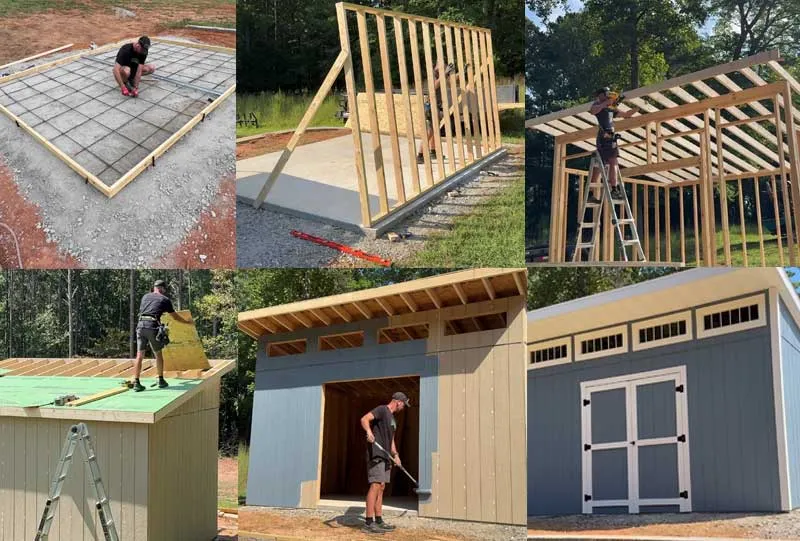
Following is the edited excerpt of an interview between veteran shed craftsman Jim “Rusty” Williams and syndicated reporter Bridget Miller-Clarke.
Bridget: Jim, I’ll be blunt. The internet is drowning in “12,000 shed plans” packages for $37. People are skeptical. Give it to me straight. What is this collection, who is it actually for, and why should a person spending their hard-earned Saturday in the dirt trust you?
What makes these "Good-Enough Blueprints" better than other shed plans out there?
Jim: Look, I’m a dirt-under-the-fingernails kind of guy, not a software developer. I’ve spent decades hauling lumber in the rain and fixing “pro” sheds that started leaning after two seasons. Good-Enough Blueprints Vault isn’t a library of every shed ever conceived by man. It’s a curated, and battle-tested collection of the structures that actually work in an American backyard.
- What it is: A digital vault of blueprints and DIY guides to build sheds, garages, and barns that I have personally vetted, corrected, and in many cases, built myself. These aren’t just drawings; they are construction roadmaps with actual material lists that don’t leave you short three 2x4s at 4:00 PM on a Sunday.
- Who it’s for: The homeowner who owns a circular saw, a level, and a bit of grit. It’s for the guy who wants a shop or a mower shed that won’t sag when the snow hits or rot when the humidity climbs. It’s for people who value their time and don’t want to play “guess the measurement” halfway through a rafter cut.
- Who it’s NOT for: If you’re looking for a “Lego set” where everything is pre-cut and you just turn a hex key, go to a big box store and buy a plastic resin shed. If you want a backyard cathedral with mahogany inlay and zero structural integrity, these aren’t for you. These are working buildings.
- Why it exists: Because most online plans are drawn by guys who have never swung a 22oz framing hammer. They look pretty on a tablet, but the load paths are wrong, the headers are undersized, and they don’t account for how wood actually moves. I got sick of seeing neighbors waste $3,000 on materials only to have the door stick forever because the floor frame was flimsy.
- Why it’s different: I call them Good-Enough because in the trades, “good enough” means it’s square, it’s plumb, it’s overbuilt where it counts, and it’s going to outlast your mortgage. It’s not about architectural vanity; it’s about practical, repeatable success. I’ve stripped out the fluff and kept the structural truth.
Bridget: You’ve got a reputation for being a bit of a hard-nose about fancy plans. You often say that choosing the wrong blueprint is a “quietly dangerous” mistake. That sounds like a bit of a scare tactic, Jim. Is a shed really that high-stakes? What’s the worst that happens, a leaky roof?
Why is choosing the wrong shed plan such a big deal, and can you share a time where you personally learned that lesson the hard way?
Jim: A scare tactic? Go walk around any suburban neighborhood five years after a DIY boom. Look at the ridgelines. See that “swayback” look where the middle of the roof dips? That’s not character. That’s a structural failure because some plan told a guy he could use 2×4 rafters on a 12-foot span with a 4/12 pitch. It’s dangerous because wood is heavy, and snow is heavier. If that roof collapses while you’re under it tinkering with your mower, it’s not a “oopsie,” it’s a trip to the ER.
Most plans online are quietly dangerous because they lie by omission. They don’t tell you about the load path. They don’t tell you that if you don’t tie your rafters to the top plate with more than a prayer and a finishing nail, the walls will “splay” out under the weight.
I learned this the hard way back in ’99. I was cocky. I was building a 10×12 gambrel for a neighbor. I followed a sketch I found in a popular woodworking magazine at the time. The plans didn’t specify the floor joist spacing for “heavy use,” just a generic 24 inches on center. I didn’t know better then. I used 2x6s, thinking it was just a shed.
Three years later, the neighbor calls me. He’d put a heavy cast-iron table saw and a riding mower in there. The floor had developed a “bounce” that would make a trampoline jealous. Within five years, the moisture from the ground, which the plans didn’t mention a vapor barrier for, had wicked up into those widely spaced joists. The floor literally rotted out from the center. I had to go back, jack the whole building up, and sister in new joists. It was miserable, muddy, expensive work. I lost money, I lost sleep, and I nearly lost a friend.
The lesson? A shed is a building, not a piece of furniture. It deals with wind shear, frost heave, and gravity 24/7. If your plans don’t respect the physics of the site, the frost depth, and the drainage then you aren’t building an asset; you’re building a future pile of debris. These Good-Enough Blueprints are designed so you never have to crawl under a finished building to fix a mistake that should have been caught on paper.
Bridget: That’s a sobering thought. But let’s talk about the meat. A person clicks buy, they get access to the vault, what’s actually in there? Is it just PDFs of drawings, or is there more to the “Good-Enough” method?
What exactly is included in the vault, and how did you organize it so a person doesn't get overwhelmed?
Jim: It’s a big library, but I’ve organized it like my own workshop: everything has a place. You aren’t getting a zip file named “SHED_PLANS_FINAL_V2.” You’re getting a categorized system.
Here’s the breakdown of what’s inside:
- The Master Blueprints Vault: We’re talking hundreds of designs. From 4×8 lean-tos that fit behind a garage to 16×24 She-Sheds, garages and workshops that are basically small houses. We’ve got saltboxes, gambrels, classic gables, and even some specialized stuff like potting sheds, greenhouses and firewood bunkers. We even have blueprints for huge 40×60 pole barns.
- Comprehensive Material Lists: I hate “ballpark” lists. My lists tell you exactly how many sticks of lumber, how many sheets of sheathing, and how many boxes of 3-inch 16D galvanized nails you need. I even include a waste factor, so you aren’t driving back to the yard for one single piece of drip edge.
- Special DIY Guides On Foundations & Roofs: This is where 90% of DIYers fail. I’ve included specific guides on foundations built with skids, concrete piers, and gravel pads. I’ve laid out my DIY guide so even a guy who’s never notched a board in his life can craft a roof that’s as rock-solid as a mountain.
- Step-by-Step Framing Logic: We don’t just show the finished wall. We show you the exploding view. You see how the king stud meets the header, how the trimmers support the door, and how to dead-wood the corners so you actually have something to nail your interior finish to later.
- Plans organized by size and style. You don’t have to wade through 50-foot barn plans if you just want a place for your trash cans. You pick your footprint, pick your roof style, and the system hands you the keys. It’s designed to take you from “I think I want a shed” to “I’m swinging a hammer” in about twenty minutes of reading.
Bridget: You mentioned She-Sheds, garages and workshops. Now the person reading this may not be a pro. They might be a dad who’s never built more than a birdhouse, or a retiree looking for a project. Am I going to need a $5,000 tool kit and a degree in structural engineering to read these?
Who is this blueprint collection truly for, and are these plans actually beginner-friendly?
Jim: Let’s clear something up: “Beginner-friendly” usually means dumbed down. I don’t dumb things down. If you’re building a structure that weighs two tons, you need to know the truth. However, I make that truth accessible.
If you can read a tape measure, use a level, and operate a circular saw without cutting a finger off, you can build from these plans. I’ve had guys who didn’t know the difference between a carriage bolt and a lag screw finish 10×12 workshops that look better than the pre-fab junk you see in parking lots.
Who this is for:
- The Practical DIYer: You have a basic set of tools: drill, saw, hammer, level and you’re willing to sweat. You want the satisfaction of saying “I built that,” and you want to save the $3,000 to $5,000 a contractor would charge for labor.
- The Overbuilder: If you’re the type of person who researches the best oil for your truck for three weeks, you’ll love this. I give you the specs to build something that will be there when your grandkids are grown.
- The Budget-Conscious: You know that buying the wrong materials is the fastest way to blow a budget. These plans keep you lean.
Who it’s NOT for (and I’m being serious):
- The “Good Enough” (in a bad way) Guy: If you think “level” is just a suggestion and you want to eyeball your rafter cuts, please don’t buy my plans. You’ll just get frustrated when things don’t line up.
- The Tool-Phobe: If you’re scared of a power saw, hire a pro. Building a shed is physical work. It’s rewarding, but it’s not clicking a “generate” button.
I’ve designed the instructions to be jargon-free. When I use a trade term like “on center” or “birdsmouth cut,” I explain exactly what it means and why it matters. I treat the reader like an apprentice on my job site. I’m not going to do the work for you, but I’m going to make sure you have every piece of info you need so you never feel stuck.
Let's address the name. Good-Enough Blueprints. That sounds like you're settling for "Okay." Why not call them Perfect Blueprints or Professional Architect Series?
Jim: Because “Perfect” is a lie told by people trying to sell you something you can’t build.
In the real world of construction, nothing is perfect. The lumber you buy from the big box store is going to be slightly bowed. Your backyard isn’t perfectly level. Your circular saw might be off by a 1/32nd of an inch.
When a pro says a job is “Good Enough,” it’s actually a high compliment. It means:
- It’s structurally sound: It’ll handle the wind, the snow, and the weight.
- It’s buildable: A human being with a hammer can actually execute the plan without needing a CNC machine.
- It’s practical: It doesn’t use over-complicated joinery where a simple nail-fin will do.
These aren’t vanity plans. I’ve seen architectural plans for sheds that require custom-milled rafters and complex steel plates. Who has time for that? Good-Enough Blueprints focus on Safety, Simplicity, and Longevity.
We use standard lumber sizes. We use common angles (mostly 22.5, 45, or 90 degrees). We use techniques that “self-correct” for the fact that wood moves. It’s Good Enough to last 40 years. If that’s not good enough for you, you’re probably looking for a museum piece, not a tool shed.
Now what are the absolute DO NOTS that you see DIYers doing repeatedly?
Jim: That list is long, and most of it comes from people trying to be smart instead of being practical. I’ve seen it all, sheds sinking into the mud, roofs flying off like kites, and floors so bouncy you’d think they were trampolines.
If you want your shed to outlive your mortgage, here are some of the absolute “DO NOTS” you need to tattoo on your brain before you touch a saw.
DO NOT set your shed directly on the grass.
I don’t care if the wood is Pressure Treated. Ground contact is a slow death sentence. I see guys throw a couple of 4x4s on the lawn and start framing. Within two seasons, the moisture from the soil is sucked up into that wood like a straw. Termites find it, rot sets in, and the whole thing starts to settle unevenly.
Always, always have a capillary break. Whether it’s a crushed stone pad or solid concrete blocks, get that wood off the dirt so air can move underneath.
DO NOT use Interior fasteners to save five bucks.
This one kills me. A guy spends two grand on premium cedar or SmartSide, then uses standard “gold” screws or bright box nails because a box of galvanized costs ten dollars more. Modern pressure-treated lumber is packed with copper. When that copper gets wet, it creates a chemical reaction that eats standard steel for breakfast. In five years, your floor joists won’t even be attached to your skids. They’ll just be “hovering” there on rusted-out nubs.
If it’s outside, it’s Hot-Dipped Galvanized or Stainless Steel. No exceptions.
DO NOT skip the Drip Edge.
Most “easy” plans leave the drip edge off because it’s an extra trip to the store. Without it, water runs off your shingles, curls back under the edge, and soaks into your roof decking and your fascia boards. Within three years, the edges of your roof will be soft as wet cake.
Install the metal drip edge. It costs peanuts and saves you from replacing the whole roof in five years.
DO NOT Over-Engineer the wrong parts.
I see DIYers use 2x8s for wall studs because they want it “strong,” but then they use 1/2-inch OSB for the floor. That’s backwards. Your walls carry the weight, but your floor carries the abuse.
Use the right lumber for the right load. My plans tell you exactly where to beef it up and where you’re just throwing money away.
DO NOT close off the bottom of the shed.
People want to put “skirting” around the base to hide the blocks and make it look like a house. Unless you’ve got massive ventilation, you’ve just built a humidor. That trapped moisture will rot your floor from the bottom up.
If you must skirt it, use lattice or something that lets the wind howl through there. Dry wood is happy wood.
And what if someone needs only one shed plan? Can they get a single blueprint from your vault?
Jim: I get this one a lot. A guy comes to me and says, “Jim, I just want a simple 8×12 garden shed to keep the lawnmower out of the rain. Why do I need a hundred plans when I’m only ever gonna build one?”
It’s a fair question, but it’s the wrong way to look at the job. You don’t know which shed you’re building until you’ve seen the options you didn’t know you had. When I was just starting out, I’d have a homeowner tell me they wanted a “standard shed.” I’d show up with a gable-roof design, and halfway through the framing, they’d see a neighbor’s gambrel roof and realize they could have had a loft for their seasonal storage. Suddenly, I’m tearing out rafters and changing the pitch because they didn’t have the “menu” in front of them on day one.
I don’t sell single plans for the same reason I don’t sell a single socket out of a wrench set.
If I sold you one plan for twenty bucks, and you got halfway through and realized your HOA has a height restriction you forgot about, or you realized your backyard slope makes a lean-to way more practical than a saltbox, you’d be stuck. You’d have to go back to the well and pay again.
By giving you the entire vault, I’m giving you “Project Insurance.” You might start looking for a 10×10, but then you see the cut-list for the 10×12 and realize for an extra fifty bucks in lumber, you get twenty more square feet of floor space.
Maybe you build the 8×10 Workhorse this year. But two years from now, you’re tired of your trash cans sitting by the garage, and you want to knock out a quick 4×8 lean-to over a weekend. You’ve already got the plans. You don’t have to go back to the plan websites and risk getting burned again.
Single-Sellers Have Their Place
Sites like ICreatables.com, ShedPlans.org, and TimberFrameHq.com will all gladly sell you a single plan at $20-$30. Some sites will even create a custom plan or customize a design for you at around $90. And they all assume that you are already an expert builder who knows exactly what you want and how to build it.
By opening the whole vault, I’m saying, “Here is everything I know about every shape and size of outbuilding.” You can compare the framing of a heavy-duty workshop against a light-duty potting shed. You can see why I use a double-header on one and a single on the other. You’re not just buying a blueprint; you’re buying a Library of Solutions.
If I sold these plans one by one, I’d have to spend all my time doing customer service for guys who bought the wrong thing. I’d rather give you the keys to the whole shop and let you pick the tool that actually fits your hands.
So, no, I don’t break up the set. It’s the whole Good-Enough collection or nothing. Because in my experience, the one plan you think you need is rarely the one you end up finishing. I’m saving you from your own first guess.
And what would you say to a person who feels they can just "wing it" and doesn't need to pay for any shed plans?
Jim: “Winging it” is the most expensive way to build a shed.
I’ve seen it a thousand times. A guy thinks he’s saving money by not buying a plan. He spends $2,500 on lumber. He cuts a header wrong; there goes $60. He miscalculates his roof pitch and has to buy four more sheets of OSB; there goes $100. He realizes his floor is out of square when he tries to put the siding on, so he has to “shim” everything, which takes him an extra two days of frustrated labor.
My “Good-Enough Blueprints” aren’t a cost; they’re an insurance policy. I’m giving you the Job-Site Wisdom that usually takes a decade to learn. I’m giving you the confidence to walk into the lumber yard and speak the language. I’m giving you a structure that you can be proud of, one that doesn’t sag, doesn’t rot, and doesn’t make you look like an amateur to your neighbors.
These plans are my legacy. I want you to build something that lasts. I want you to feel that “click” when the last shingle goes on, and you realize you built a real, reliable building with your own two hands.
If you follow these plans, you will have a shed that is “Good-Enough” for me to stand under in a hurricane.
Jim: Now we’re getting to the meat of it. You’re right, if some guy goes typing “Jim the Shed Builder” into the Google machine looking for a LinkedIn profile with a suit-and-tie headshot or a TikTok dance video, he’s gonna come up empty-handed.
I’m an off-grid ghost, and I’m that way on purpose.
See, there are two kinds of experts in this world today. You’ve got the “Digital Carpenters“, the guys who spend four hours a day editing videos, buying likes, and worrying about their personal brand. They have beautiful websites, but if you look at their hands, they don’t have a single scar. Their hammers are shiny because they only use ’em when the camera is rolling.
Then you’ve got guys like me.
My “Digital Footprint” is Built of Pressure-Treated Lumber
For the last thirty years, I haven’t been building a social media presence. I’ve been building structures. My reviews aren’t star-ratings on a search engine; they’re the thousands of sheds standing tall in backyards from Maine to Montana. They’re the workshops that didn’t cave in during ice storms and the potting sheds that are still square thirty years after I drove the last nail.
If you don’t find a “Jim” with a fancy bio, it’s because I’ve been busy in the field, not in a cubicle. The savvy consumer you’re talking about needs to ask himself one question: Do I want to buy plans from a marketing agency, or from a guy who’s actually had mud on his boots?
In the trades, the best guys are often the hardest to find online. Why? Because we’re perpetually backed up with work. Word of mouth is the only algorithm I’ve ever needed. I’m only putting these Good-Enough Blueprints online now because I’m at the age where my knees yell at me when I climb a ladder, and I want to pass this down before I put my tools away for good.
If you’re skeptical because I don’t have a blue checkmark next to my name, I get it. We live in a world of scams. But a scammer gives you a “perfect” polished product that fails the first time it rains. I’m giving you a “Good-Enough” product that’s been battle-tested in the real world.
I’m a ghost because I value my privacy and I value the work. I’m not selling Jim. I’m selling the Blueprints. The plans have to stand on their own. If the math is right and if the structure stays standing, who cares if the guy who wrote it doesn’t have a Facebook page?
The savvy guy doesn’t look for a celebrity. He looks for Expertise. Now, look, I’m not asking you to buy a pig in a poke. If you want to see how I think before you lay down a dime, head on over to ShedDrafts.com. I’ve got a mountain of free plans sitting over there for anyone to look at.
Now, full disclosure: that site has ads running all over it. I’ve gotta keep the lights on and pay for the hosting somehow, and those ads help cover the costs of keeping that information free for the public. But it’s a good place for you to flip through those designs, look at my framing layouts, and get a real feel for my style and how I put a building together.
If you like what you see on the free site, you’re gonna love what’s in the vault. The vault plans are the “Pro-Grade” versions; cleaned up, beefed up, and ready for a thirty-year lifespan without the distraction of a bunch of flashing ads in your face. Go take a look, then come back here when you’re ready to build for real.
I have to ask about the refund policy. Most online products have a 60-day money-back guarantee. You don't. Why? Isn't that a bit of a red flag for a skeptical buyer?
Jim: It’s a red flag for people who sell junk. For me, it’s just being honest about how the digital world works.
Here’s the plain truth: There are no refunds on the Good-Enough Blueprints because once you buy this, you get immediate access to my entire vault. You can download every PDF, every material list, and every DIY guide to your hard drive in about ten minutes.
On the platforms we use, there’s no way for me to “take back” those files. If I gave a refund, you’d still have the plans. In my world, you don’t walk into a restaurant, eat the steak, and then ask for your money back because you’re “not sure” if you liked it.
I’m building a community of serious builders, not tire-kickers. If you’re the kind of person who is already looking for the exit before you’ve even started the project, you probably shouldn’t be swinging a hammer anyway.
I’ve put all of my life’s work into these plans and guides. I’ve made the $5,000 mistakes so you don’t have to. If that isn’t worth the price of the collection to you, then we aren’t a good fit. I’d rather lose a sale than deal with someone who doesn’t value the hard-earned knowledge I’m handing over.
Trust is a two-way street. I trust you with my life’s work; I expect you to trust that I’m not here to scam you out of a few bucks. I’ve got a reputation in this trade, and I plan on keeping it.
Jim: I figured you’d call me on that. In the world of “click here” and “limited time offers,” it smells like a sales tactic. I get it. If I were sitting in your chair, I’d be thinking the same thing: “It’s a digital file, Jim. It doesn’t cost you a dime more to sell a thousand than it does to sell ten.”
But that’s where the marketing logic and job-site logic have a head-on collision.
I’ve seen what happens when you open the floodgates. You get 5,000 people trying to build 5,000 sheds at the same time. Suddenly, my inbox is full of guys asking, “Hey Jim, my local lumber yard only has 2×6 hemlock, can I swap that for the PT fir in your 10×12 plan?” or “Jim, I’m building on a 15-degree slope in North Carolina, how do I adjust the skid height?”
And as you already know I’m an off-grid ghost. These days, I spend more time at my cabin up by the lake than I do in town. It’s got no electricity, no running water, and I leave my cellphone in the glovebox of the truck, usually turned off. Sometimes I’m gone for a month at a stretch, just me, the timber, and the quiet.
Now, when you buy into this Good-Enough Blueprints vault, you’re gonna see a customer support email address in your welcome packet. I want to be brutally frank with you: You aren’t reaching me at that address.
To be real honest, the person on the other end of that keyboard is my cousin’s kid. Now, don’t get me wrong, she’s a total wiz when it comes to the “magic” of computers. If your link won’t click or if the PDF won’t open, she’ll have you fixed up in five minutes flat. She’s the reason this vault even exists online.
But she’s not a builder. If you email her asking about the structural load of a double-header or how to notch a birdsmouth on a 6/12 pitch, she’s gonna look at you like you’re speaking Greek. She doesn’t know a shim from a shoulder-bolt. That’s why I spent three decades pouring every ounce of job-site wisdom into the plans and DIY guides.
I’ve designed these blueprints to be Self-Sufficient. I wrote them assuming I’d be at the lake without a signal when you’re standing in your backyard with a circular saw in your hand. I’ve answered the “what-ifs” and the “how-tos” inside the documents so you don’t need a lifeline.
If you’re the kind of person who needs a hand-held coaching session every time you drive a nail, this probably isn’t the collection for you. But if you want the blueprints that were drawn by a man who knows what it’s like to be stuck in the middle of a build with nobody to call, and made sure you’d have the answers right there on the paper, then you’re in the right place. She handles the tech; I handle the timber. Between the two of us, you’ve got everything you need to get the job done.
There’s also another practical reason. I want to see how these 100 folks handle the digital vault. Is the layout clear? Does the template print out right on a home printer? I want to refine the “Good-Enough” system with a small group of serious DIYers before I even think about opening it up further.
I’m capping this at 100 because I’m one man, and a hard-to-reach one at that. I want to make sure the first 100 people who put their trust in me actually get their sheds built. I want to be able to look at the photos they send me, the finished, square, solid structures and know that my plans did the heavy lifting even when I wasn’t there to yell across the job site. I want to know that the Good-Enough logic held up, the trusses lined up, and the doors swung true, all because the wisdom was on the paper.
Most mega-plan sites thrive on you not building the shed. They want your $27, and then they want you to forget you ever bought the plans. They profit from your failure or your procrastination. I’m the opposite. I want you to build the damn thing. If I have 1,000 people, it becomes a business. At 100 people, it’s still a craft.
If that means I leave money on the table, so be it. I’ve lived my whole life by the rule that it’s better to do a small job perfectly than a big job poorly. If you’re one of the 100, you’re getting the best of what I’ve got.
Final question, Jim. A person is sitting there, their credit card is on the desk, but they're worried they'll get halfway through construction and get stuck. What's your final word to them?
Jim: Listen, as I said at the start, I’m a dirt-under-the-fingernails kind of guy, not a software developer. I’ve been in that exact spot. Standing in the middle of a project, surrounded by three hundred dollars’ worth of sawdust and a pile of lumber that doesn’t look a lick like the picture on the box. It’s a sinking feeling. It’s the “What the hell was I thinking?” moment.
But here is my final word to you: The reason you get stuck isn’t because you lack the skill; it’s because your map ran out of road.
Most plans leave you stranded right when things get hairy. They show you a pretty picture of a finished roof, but they don’t show you how to brace the ridge board while you’re working solo. They don’t tell you what to do when your foundation is a half-inch out of square. That’s where the “stuck” happens.
In the Good-Enough Blueprints vault, I’ve built in the “Exit Ramps.” I’ve spent decades making those mistakes so I could write down the fixes. I’m not just giving you the “what”, I’m giving you the “and if this happens, do this.” It’s like having an old-timer standing right there next to the miter saw, pointing at a board and saying, “Careful there, son, shim that corner before you nail it.”
Look at your credit card. It represents your hard-earned money. You can spend that money on a pre-fab shed made of “glorified cardboard” that’ll be a leaning eyesore in five years, or you can invest it in the knowledge to build something that your grandkids might one day use to store their own tools.
You aren’t just buying paper; you’re buying the confidence to finish. If you can read a tape measure and follow a cut-list, I’ve taken the “guesswork” out of the equation. I’ve redlined the traps and highlighted the shortcuts that actually work.
The door to the vault is only open for 100 people because I want 100 success stories. I want 100 folks who can crack a cold one on a Sunday afternoon, look at a solid, square building in their backyard, and say, “I built that, and I did it right.”
Pick up the card. Get the plans. Start the layout this weekend. You’ve got the best roadmap I know how to draw, and I’ve made sure the road doesn’t end until the roof is capped and the door swings shut with a solid thud.
I’ve done my job at the drafting table. Now it’s time for you to do yours on the job site. Let’s get it done.
Good-Enough Blueprints Vault Offers
257 Pro Shed Plans Organized By Size & Style
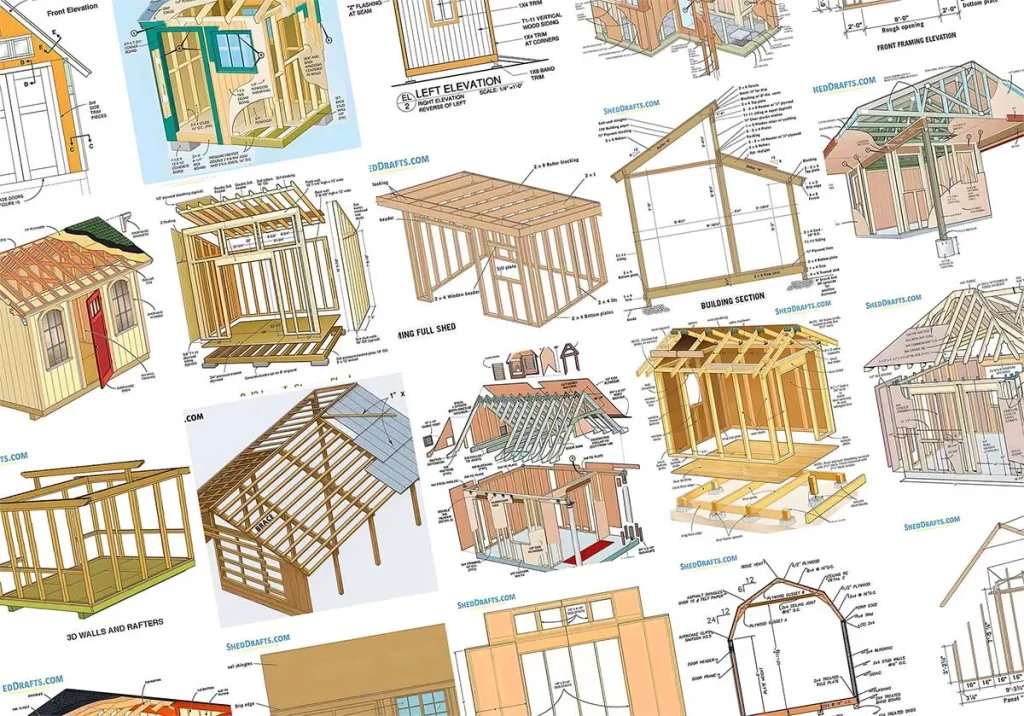
These include all the best plans found on the ShedDrafts.com website (improved with additional details), plus extra plans not found on the site.
Every footprint you could need to park a mower or build a man-cave. From classic 8×12 garden sheds, the bread-and-butter 10x12s, the big-boy 12×16 and 12×24 workshops, and many more layouts. If you’ve got a weird corner in your yard, we’ve probably got a footprint that’ll tuck right in there.
Whether you want a simple Lean-to that will sit against a fence, a classic Gable, a barn-style Gambrel with the extra loft space, or even the fancy stuff like Saltbox and Hip roofs, it’s all in the vault.
How To Build A Pro-Grade DIY Shed And Avoid 21 Costly Mistakes
Most guides tell you how things should go. This one tells you what to do when things go wrong, and more importantly, how to make sure they don’t go wrong in the first place. This is the manual that bridges the gap between a paper drawing and a standing structure.
It’s a Step-by-Step Tactical Manual that breaks the build down into the seven phases that matter: Site Prep, Foundation & Floor, Wall Framing, Roof Framing, Doors & Windows, Exterior Sheathing, and Finish.
And the gravy of this guide are the 21 Costly Mistakes. These are the silent killers of backyard buildings.
How To Build A Weather-Proof Shed Foundation Step By Step
You can buy the fanciest cedar siding in the world and use the straightest lumber in the yard, but if your foundation is junk, you’re just building a very expensive pile of future firewood.
I’ve spent half my life fixing “leaning towers of sheds” because someone thought they could just plop a building on some loose dirt. This guide is about one thing: Winning the war against gravity and ground moisture.
This guide isn’t about making it look pretty; it’s about making it permanent. It’s the “invisible” work that makes people stop in ten years and ask, “How the heck is that shed still so straight?”
Total Beginner’s Guide To Frame A Pro-Grade Shed Roof
Roof framing is the Great Wall that stops most DIYers dead in their tracks. I’ve seen grown men stare at a pile of 2x4s and a framing square like they were looking at a Martian flight manual. They get terrified of the angles and the math.
This guide is designed to take that fear and kick it right off the job site. I strip away the academic nonsense and teach you “Carpenter’s Logic.” If you can read a tape measure and hold a saw, I can get you a roof that stays straight and dry.
97 Trade Secrets And Pro Tricks To Build Budget Sheds That Last Decades
This is the culmination of every “Aha!” moment I’ve had while sweating out a humid July or shivering in a November mud-pit. This isn’t academic theory; it’s the gritty, practical wisdom that separates a guy who owns tools from a guy who knows tools.
This Black Book is a rapid-fire collection of tips designed to save your money, your back, and most importantly, save your shed from the landfill.
Now that’s a total value of $1,539. For the next 100 people who step up, your investment isn’t even going to be half of that. Heck, it isn’t even going to be a quarter of it.
Because I’m looking to build a community of folks who actually build things. I want to see the photos of your finished shed and hear your personal story of building it. So, I’m opening the vault today for just $67.
That's right, just $67.

That’s less than the cost of a couple of sheets of high-grade plywood or a box of high-quality framing nails. For the price of a decent steak dinner, you’re getting thirty years of my hard-earned knowledge and a library of plans that’ll help you build any shed you want.
It’s a heck of a deal for the headaches it’s going to save you. Once those 100 spots are gone, I’m pulling the ladder back up.
So click on the green button, download the plans and guides, and start your build today.